The shoulder is the joint capable of the most complex and precise movements. It has a wide range of motion and consists of many components, including ligaments, tendons, muscles, and bones, making it a complex joint. It is also the joint most frequently used in daily life. Because of this, degenerative changes and injuries can easily occur. Recently, a patient who visited my clinic complained of shoulder pain
My shoulder makes a clicking sound, and it hurts even when I'm at rest. I've had occasional shoulder pain in the past, but it's gotten worse since I started working out recently. I found out it might be shoulder impingement syndrome. Is it okay to continue exercising like this? I came to get a proper examination and treatment
In this session, we will discuss what shoulder impingement syndrome is, its causes, and its symptoms.

What is Shoulder Impingement Syndrome?
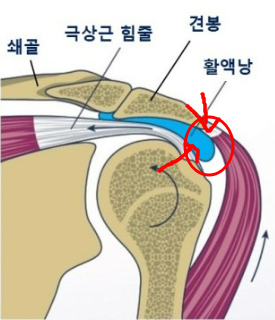
As the name suggests, shoulder impingement syndrome is a condition where impingement occurs in the shoulder joint. The space within the shoulder joint narrows, causing the structures known as the acromion and the head of the humerus to collide. This impingement can damage the rotator cuff tendons or the subacromial bursa, increasing joint instability. It is one of the common shoulder disorders that can occur in middle age. Impingement is particularly severe during movements that involve raising the arm overhead or extending the arm backward. Pain is often accompanied by a 'clicking' sound. It frequently occurs in athletes who heavily use their shoulders, such as swimmers or baseball players, earning it the nicknames "swimmer's shoulder" and "thrower's shoulder."
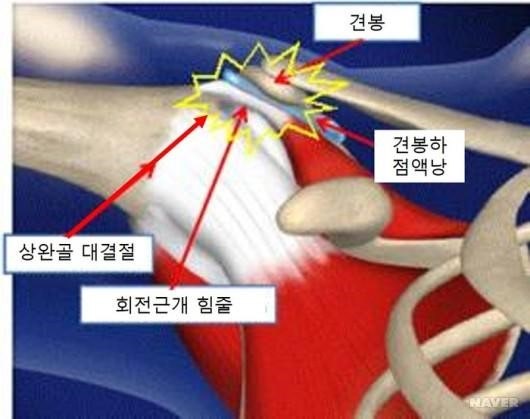
As seen in the illustration, when the arm is raised or extended backward, the muscles and bones move in the direction of the arrows, narrowing the space within the shoulder joint and causing impingement.
Causes of Shoulder Impingement Syndrome
The causes of shoulder impingement syndrome can be broadly categorized into two main types: narrowing of the joint space and increased shoulder instability.
Narrowing of the Joint Space: Degenerative Changes: Conditions such as bone spurs (osteophytes) can cause the joint space to narrow. Thickening of the Tendons: Tendons within the shoulder can become thickened, further reducing the available space.
Increased Shoulder Instability: Even if the joint space is not narrowed, increased instability in the shoulder can lead to impingement. Rotator Cuff Tendon Damage and Inflammation: When the rotator cuff tendons are damaged or inflamed, they can become weakened and fail to properly stabilize the head of the humerus (upper arm bone). Movement Issues: As a result, when the arm is raised overhead, the head of the humerus is not properly fixed in place and can move upward, causing it to collide with the acromion
Symptoms of Shoulder Impingement Syndrome
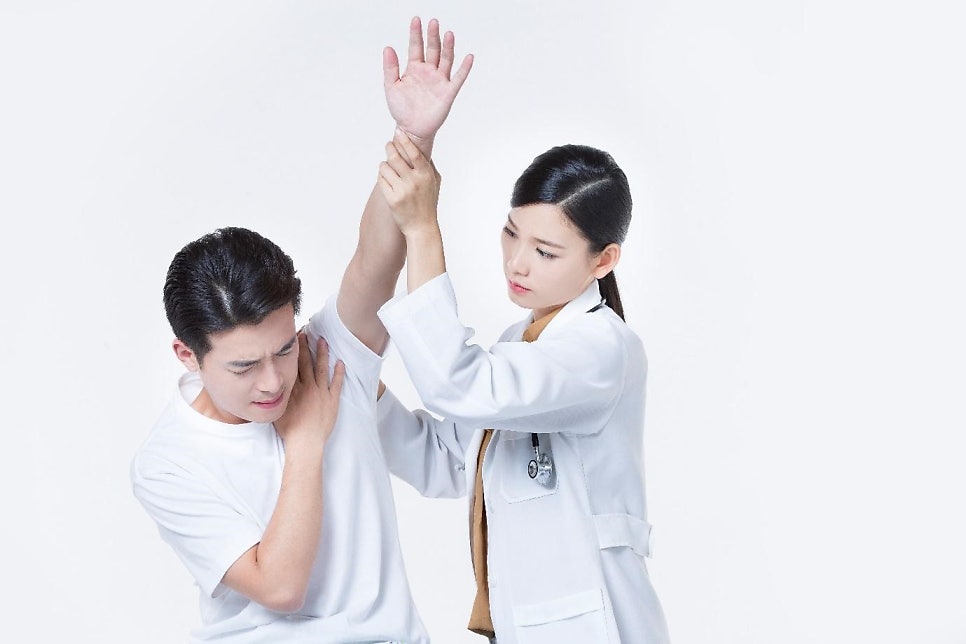
The main symptoms of shoulder impingement syndrome are a 'clicking' sound and pain.
Pain and Clicking Sound: The primary symptoms include a noticeable 'clicking' sound and pain during shoulder movement. Worsening Pain: Repeated impingement can lead to increasing damage and worsening pain. As the condition progresses, pain may persist even at rest, and the clicking sound can become loud enough for others to hear. Pain at Rest: Similar to other shoulder joint disorders, the pain often worsens when lying down, as the space within the shoulder joint becomes even narrower. This can lead to sleep disturbances due to pain. Differential Diagnosis: It is important to differentiate shoulder impingement syndrome from other shoulder conditions such as frozen shoulder (adhesive capsulitis). Additionally, it is crucial to identify any accompanying injuries, such as rotator cuff tears.
Proper diagnosis and differentiation from other shoulder disorders are essential for effective treatment and management.
Seoul Painfree Rehabilitation Medicine Clinic Strives for Personalized Treatment
Every patient has a unique body type, posture, occupation, and lifestyle. This is why a standardized treatment approach is not suitable, even for the same condition. We must provide ‘personalized treatment’ that fits each patient’s specific condition.
At Seoul Painfree Rehabilitation Medicine Clinic, we strive for personalized treatment through weekly case studies. Through these studies, our entire medical team researches and discusses how to provide the most appropriate and effective treatments for our patients.
All our staff work with a sense of mission to restore the health of our patients. For those who wish to receive treatment at Seoul Hwaljjakpyeon Rehabilitation Medicine Clinic, please refer to the following medical guidelines for your visit.
Thank you.